Monday, June 29, 2009

Geoffrey Nunberg - The Years of Talking Dangerously

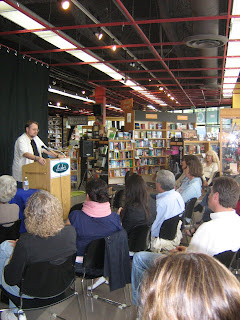
Geoffrey Nunberg came to Kepler's on June 25, 2009 to discuss his most recent book, The Years of Talking Dangerously. Event host Bobbi Emel reports:


Sectarian violence aimed at expressing differences. Or, as most would describe the Sunni-Shia conflict in Iraq: civil war. Obviously, a White House press secretary went to great lengths to not use the words "civil war" only to be caught by Berkeley professor and "rock-star linguist" Geoffrey Nunberg who promptly broadcasted this particular inanity on Fresh Air and then plopped it in his new book, The Years of Talking Dangerously. An anthology of his commentaries on NPR's Fresh Air, The Years of Talking Dangerously is an interesting and humorous look at events around us and the way we use words, or manipulate words, to describe them.

A large crowd came to Kepler's to hear Geoff Nunberg talk about everything from the Bush Administration's incredible gyrations to avoid "the torture word" to the struggles of dictionary editors to define words like "love," "girlfriend," and "marriage" in a world where same-sex marriage is becoming more of a reality. Dr. Nunberg is a droll and entertaining speaker. In my interview with him after the event, I asked him what he thought the Word of the Year should be. He responded that it will probably be something boring like "credit default swap." When I asked him what the Word would be if he had the deciding vote, he said it would be "Tweezer," a word he made up to describe people over 50 who use Twitter. By the way, he thinks Twitter is a great invention because it causes people to communicate in 140 characters or less. I was surprised and remarked that I thought linguists would want people to become more verbose, rather than less. He looked chagrined and said, "No. Pithy. That's what we want. Pithy." No wonder he's a fan of Twitter and the Tweezers who love it.

Sister Marilyn Lacey - This Flowing Toward Me


Sister Marilyn Lacey came to Kepler's on June 23, 2009 to talk about her book, This Flowing Toward Me: A Story of God Arriving in Strangers. Event host Pam Grange recalled the evening:


Responding to a bulletin board posting for volunteers to help refugees at SFO in 1979, Sister Lacey embarked upon a 30-year journey that changed her life. A self-proclaimed shy person with a Type A streak, she’s a very poised and interesting speaker and, after reading selections from two of the stories in the book, she described her transformation from insular suburban California high school math teacher to a person who thinks and travels globally, and who’s doing as much as she can to help the millions of refugees and displaced persons around the world.

Through these relationships, her ways of thinking have continually been brought up short. For instance, Americans’ fixation with time – such as, “time is money,” and it’s rude to keep people waiting. Then she moved to rural Thailand to work in a refugee camp. She wanted to take a bus somewhere and was told it would arrive at 8:00 a.m. the following morning. She was ready and waiting at 8:00. After two or three hours of sitting in the increasingly roasting hot bus and sharing it with other passengers such as live chickens, she was getting perturbed. Finally, after cobbling together her question from the Lao phrase book, she approached the driver and as politely as she could asked, “When. Will. The. Bus. Leave?” “When it gets full,” he said.

Aside from Thailand, Sister Lacey has also lived in refugee camps in Africa, including southern Sudan and Kenya. She saw many awful things and went through periods of being very angry with God. “For those who believe in a loving God, the horror these refugees endure raises searing questions. Suffering, particularly the suffering of innocent children, tears at the heart, threatening to unravel belief and unleash despair.” She subsequently had a moment of enlightenment one afternoon, while browsing the poetry aisle of Kepler’s. She picked up a volume of Rumi’s poetry, “Open Secret”, and read a poem that brought her peace.

Sister Lacey is totally convinced that we need the values that refugees are bringing to us. A women in one of the camps asked her one day if it were true that in the U.S. it was one person – one room and one person – one plate. She replied, somewhat proudly, that yes, it was relatively true. The woman said to her in all sincerity, “But why would ANYONE want to live like THAT?” Privacy is not a value in many parts of the world.

Sister Lacey also shared some of the cultural differences she faced – which are hilarious if not disgusting. Like the 5-year-old girl she saw walking a scarab beetle on a string. Or the time she was with a group that came across a man roasting chicken in a roadside stand. It smelled great, but she thought to herself, what a shame that it’s all charred and black. After the driver paid for several pieces and they were placed on a palm leaf, the blackened char suddenly flew away! To her horror, the “char” was a solid swarm of black flies!

Then there’s the one about her discovery of what looked like a misshapen volleyball hanging from a tree. On closer inspection, she saw thousands and thousands of large red ants climbing the tree and entering the strange “ball”. When she mentioned it that night to the Sisters in the convent, “there was a respectful pause after which the eldest pronounced in Thai four simple words that affixed themselves horribly to my brain: ‘Yes. Next month. Delicious.’”

Sister Lacey has one major phobia: spiders. As her work took her to new continents and new refugees, she encountered more and more hideous 6- and 8-legged adversaries that tested her. She arrived in Kenya one day and, as she usually did, asked what particular danger she should try to avoid. Responses varied from camp to camp, but this one was infamous for its camel spiders. She asked how she would know which spiders were camel spiders. “Oh, you will know,” came the reply, “by their size and their speed. All you’ll see is the blur going by.” They’re the color of sand, have no humps, and can move 10 mph….much faster than a human. They’re actually solifugids, a frightful cross between a spider and a scorpion and grow to six inches in length. They also are fiercely aggressive when cornered. Let’s just say that Sister’s eventual match-up with one had me laughing out loud, and it’s a good thing she was a terrific baseball pitcher when young!

Sister Lacey’s main message was that welcoming strangers is the secret to happiness and that we have a lot to learn from them. It is extremely humbling to watch these poor beaten people who have nothing, including enough to eat, be so grateful for everything they do have and show such kindness to others.

A lot of her friends and co-workers were in the audience, and it was something of a reunion party. Sister Lacey is also the founder of non-profit Mercy Without Borders, whose mission is to partner with displaced women and children overseas in ways that help them move out of extreme poverty. All in all a great event and a terrific book.

Thursday, June 25, 2009

Don Joseph Goewey - Mystic Cool


Local author Don Joseph Goewey came to Kepler's on June 24, 2009 to discuss his book Mystic Cool: A proven approach to transcend stress, achieve optimal brain function, and maximize your creative intelligence.

Host Bobbi Emel reports:

I approached the reading of Mystic Cool with some skepticism. Being a therapist and having read MANY books on stress management, I was hoping I would not read another book with advice about taking deep breaths and soaking in the tub to manage stress. (Not that there's anything wrong with that.) I was surprised and pleased to read a very helpful book that combines neuroscience, cognitive processes, and spirituality to address overcoming the fears and worries that plague most people in western society. Local author Don Goewey has written a very accessible book that not only gives background on the mechanisms of stress but includes concrete, somewhat evocative exercises for the reader that will certainly help to reduce stress and increase feelings of peace and well-being.

Because of the street fair in Menlo Park and the parking problems thereof, I was concerned that we would have a small audience for the author. However, people began to trickle in at about 7:20 and then the group turned into a crowd as the Goewey family poured in from Borrone's next door. Three of Don's four sons were in attendance with their wives and Don's seven grandchildren. Don's wife, consultant and coach Louise Franklin, was also in the audience.

Don is an engaging speaker and gave a great synopsis of his book then took questions from the audience. Both Don and Louise remarked to me afterwards what a lively audience we had with astute, thought-provoking questions. Many of the questions had to do with an "epiphany" that Don describes in his book and also spoke of at the event. This epiphany came from a time when Don was completely overwhelmed with stress and began to sink down into a very dark place of anxiety and hopelessness. Suddenly, he came out of it and felt an incredible sense of peace and bliss. From this epiphany, which he says he can't really explain - "maybe it was biochemistry, maybe it was a miracle" - came his research and work which eventually became Mystic Cool. (The title is his phrase for what others call "being in the zone" or "experiencing bliss.")

Audience members were curious about this epiphany and one woman observed that others such as Eckhart Tolle and Byron Katie had similar events occur with them. Another man wanted to know if "average people" who hadn't had this type of epiphany could come to the same kind of peace that Don experiences. After much discussion about this, Don explained that, although he had experienced his epiphany, he eventually went back to struggling with fear and anxiety and so has to practice what he preaches on a daily basis. And one could tell from the way he spoke that he truly believes and lives the philosophy of Mystic Cool.

This is a terrific book and an easy read that will help many people integrate more peace and less stress in their lives.

Monday, June 22, 2009

Stan Goldberg - Lessons for the Living


Local author Stan Goldberg came to Kepler's on June 17th, 2009 to read from his book, Lessons for the Living: Stories of Forgiveness, Gratitude, and Courage at the End of Life. Event host Bobbi Emel reports:


I wasn't sure how many people would come to this event as the topic, end of life issues, sometimes makes folks fairly anxious. 25 gentle and supportive audience members came to hear local author Stan Goldberg talk about his book, Lessons for the Living: Stories of Forgiveness, Gratitude, and Courage at the End of Life. I wish that all people who are concerned about their own death or the death of their loved ones could have been there as Stan's stories and gentle, humorous style make the subject much less scary than most of us think it is.

Stan has been a hospice volunteer in the San Francisco area for the last 6 years and his book tells several stories about some of the patients for whom he cared in the last days of their lives. The remarkable part about this book, though, is that Stan himself has cancer for which he receives treatment and which will, eventually, probably lead to his own death. Stan related that, when he was first diagnosed with cancer, he lay in bed for three months watching "Law and Order" reruns. With a mischievous grin he said, "That didn't work, so I tried going to a support group." He found that the men in the support group tended to focus on what they had lost because of their cancer. This didn't work for Stan - he wanted to focus on living and what he was gaining from his experience. This journey led him to volunteer at hospice.

Lessons for the Living is Stan's way of relating the lessons he has learned from people near death about how he should live his own life. It is funny, touching, and warm; one of those books that I had a hard time putting down. In person, Stan himself is funny, touching, and warm. With a twinkle in his eye, he shared how the side effects of the cancer treatments he is receiving are hot flashes, moodiness, and weight gain. He said now when women talk about the symptoms of menopause he chimes in,"I know, ladies, I KNOW." The women in the audience gave a sympathetic murmur when he said he can have up to thirty hot flashes a day.

Stan produced one of the most magical moments I have experienced as an event host when he told a story about a woman he visited who loved music. He had been assigned as her volunteer but, by the time he came to visit her, she was already unconscious and near death. Knowing that many people in this active dying state can still hear, Stan played for her on the Native American flute he had brought with him. When recalling this story at Kepler's, Stan reached for a cloth bag and produced this same flute. Much to our pleasure, he closed his eyes and began to play as he had for the woman in his story. He improvised the melody and the low, hauntingly beautiful notes filled the suddenly quiet store. When he finished, I looked around to see some people in the audience wiping the tears away.
Stan Goldberg has done us all an incredible favor by sharing with us the important lessons of life, taught to him by people near death. It is in these moments, at the bedside of one who has all the unnecessary accouterment of life stripped away, that one can truly learn how to live.

Wednesday, June 17, 2009

Scotty McLennan - Jesus Was a Liberal


A large audience turned out on May 26th to hear Stanford Dean of Religious Life Scotty McLennan read from his new book, Jesus Was A Liberal: Reclaiming Christianity for All. Event host Marilyn Stoddard reports:


Scotty McLennan began by reading from his preface where he lays out some of the principles of liberal Christianity: The Bible is meant to be read largely metaphorically and allegorically rather then literally. We are committed to the use of logic, reason, and the scientific method. Love is the primary Christian value, and it is directly related to the promotion of liberty and justice in society at large. There are many roads to the top of the spiritual mountain, and Christianity is only one of them. We see Jesus primarily as a spiritual and ethical teacher. Living a fulfilled life here and now is more important than speculating on what happens after we die.

He says liberal Christians are tired of either being ignored or lumped together with the Christian right. Too many people equate the views of the Christian right to the views of all Christianity. His book covers a great deal of material. He has chapters on God, Jesus, the Bible, Christian doctrine, and the church year. He covers liberal approaches to the controversial issues of abortion and same-sex marriage, also to social issues such as poverty and the environment. He has a chapter on talking to atheists and Christian conservatives. He quotes the editor of "Christian Century," who observes that because toleration is one of the central values of liberals, they "don't like to fight, but instead are always trying to accommodate people, to be inclusive even of those who are trying to exclude them."

He ends by reaching out, talking about continuing to widen the circle. "A new Christianity for America and the world must remind us that we're all in this together." "Ultimately what matters most is love and community, including a commitment to social justice." He concludes his book with defining words he listed on the first page: "Liberal Christianity for the twenty-first century must lead the way through its firm commitment to progress, the essential goodness of humanity, tolerance, and freedom."

Tuesday, June 16, 2009

Luis Alberto Urrea - Into the Beautiful North


Host Aggie Zivaljevic filed this report on a recent event at Kepler's:

Luis Alberto Urrea came to Kepler's for an afternoon event on June 9th, 2009, accompanied by his beautiful wife Cindy (see the photo). Cindy's real name is Cinderella, after her great great-grandmother. On his publisher's website Luis Alberto Urrea wrote: "I'm happily married to Cinderella. We have three kidlets: Eric, Megan and Rosario. We have a cat named Annie Oakley. And we have a parrot named Periquito.You can usually find Cinderella and me driving across America...with Goth rock and Techno and Latino music blasting out the windows. If there is such a thing as reincarnation, I will come back as Emiliano Zapata."

This was his second visit to Kepler's. The first time he toured for his book the Hummingbird's Daughter, a continuous bestseller here at Kepler's. It took him 20 years to research and write this historical novel, based on his great aunt Teresita, or Santa Teresita, considered to be a Mexican Joan of Arc.

Mr. Urrea didn't read from his new novel Into the Beautiful North. Instead, perhaps inspired by the intimate setting and audience, he decided to informally talk about his life and work. He was born in Tijuana, Mexico to a Mexican father and an American mother. Early in his childhood, his family moved to San Diego, California. He went to school in Logan Heights and then in Clairemont. He found his way out of despair through books and art. Luis spoke with bewilderment and pride about his little book being translated around the world, in far away places such as China and India. He learned that there is even such a thing as the Hummingbird Club in New Delhi, meeting once a month and wearing Teresita t-shirts! Hummingbird's Daughter has been made into a movie starring Antonio Banderas and Ivana Barquero (who recently had a role in Pan's Labyrinth).

He said that he wrote his latest novel, Into the Beautiful North, because he just wanted to have fun and make a lot of people happy, especially now, during the recession. His publicist characterized it as "Cinema Paradiso meets 'The Magnificent Seven' for girls." The story begins in the coastal Mexican village of Tres Camarones (Three Shrimps), abandoned by its men. The absent men have left a vacuum and the town women step in, led by the town first female mayor Aunt Irma and a young girl Nayeli. It’s a mythical tale in which the women take the role of the knights and save the place they love. Nayeli travels from Mexico all the way to Kankakee, Illinois to bring a couple of guys back and to find her father.

A man in the audience commented admirably on Luis' previous book 6 Kinds of Sky: A Collection of Short Fiction and its afterwords titled Amazing Grace: Story and Writer. The first story from the collection Mr. Mendoza's Paintbrush is coming out as a graphic novel in 2010, illustrated by Christopher Cardinale. The story takes place in Rosario, which is for Luis his equivalent of Macondo. Actually, when Gabriel Marquez published One Hundred Years of Solitude, people from Rosario said that Marquez used Rosario as his model for Macondo!

Here is an excerpt from Mr. Mendoza's Paintbrush: “My village is named El Rosario. Perhaps being named after a rosary was what gave us our sense of importance, a sense that we from Rosario were blessed among people, allowed certain dispensations. The name itself came from a Spanish monk, or was it a Spanish soldier, named Bonifacio Rojas who broke his rosary and the beads cascaded over the ground." Another story Bid Farewell to Her Many Horses(from the same collection) has been read on NPR selected shorts.
Luis now lives in in a 2-story house in Naperville, Illinois, in a 1958 neighborhood, a bucolic place with trees and green lawns. He writes in a loft (in between the bedrooms), at his desk by the window looking out onto a giant red oak. He tends to listen to a loud music while writing, such as Black Sabbath. He surrounded himself with books; poetry on his left side and Mexican history and religious books on his right, a few cherished objects such as bird feathers, Godzilla figurine, Route 66 sign, etc. Writing is a spiritual experience for Luis. He carries his notebook all the time and writes all the time. Yes, he is on Tweeter and recommends it as a great tool for practicing writing one line at the time!

At the end of his talk Luis announced that he has a gift for the audience. Cindy distributed plastic-coated paper fans with the drawing (artwork by Christopher Cardinale) of Tacho, a gay character from Into the Beautiful North. Above Tacho's head an inscription reads La Mano Caida, which means fallen hand, as Tacho's defiant way of boldly announcing his gayness in order to survive in an extremely macho society.

Sunday, June 14, 2009

Ayelet Waldman - Bad Mother


Kepler's event host Liz Silver reports on Ayelet Waldman's visit to read from her book, Bad Mother: A Chronicle of Maternal Crimes, Minor Calamities, and Occasional Moments of Grace.


Ayelet (pronounced "I-yell-it") is another writer who could, if she ever encountered serious writer's block, get a job doing stand-up comedy. She is a non-stop, laugh-a-minute bundle of energy--that's the manic side of her bipolarness. She speaks and reads at about 1000 words per minute. Did I mention that she is FUNNY!!? The crowd (about 75 people; maybe 2 men) seemed familiar with her work, most seemed to have seen her before, and many were familiar with Bad Mother's roots in a 2005 article in New York and the ensuing brouhaha. In this article, she confessed that if push came to shove, she loved her husband more than her children. This scandalized the mommy bloggers, not to mention the intensely religious contingent, and, eventually Ayelet went on Oprah to confront and be confronted by her critics. At the end of the day, Ayelet won the battle; Oprah was on her side, and an engaging, thought provoking and very funny book resulted.

Interestingly, the crowd really related to Ayelet more as a childrearing expert than a writer. All of the question were about her views on such controversial subjects as homework, division of domestic labor, etc. There were no specific questions about her husband, Pulitzer-Prize-winning author Michael Chabon, no questions about her writing process or how the two of them share or critique each other's work.

Ayelet read (at top speed) a chapter from the book and then took questions. She seemed ready and willing to go on forever, but just as I was wondering about stepping in front of the locomotive, she said, "I'll take one last question." It was exactly 8:30: she is a total pro.

Wednesday, June 3, 2009

Noah and Logan Miller - Either You're In or You're In the Way

Kepler's was pleased to host the charismatic Miller twins, Noah and Logan, reading from their book, Either You're In or You're In the Way:Two Brothers, Twelve Months, and One Filmmaking Hell-Ride to Keep a Promise to Their Father. Host Megan Kurashige:


The Miller brothers are charming, energetic, and likeable. They engaged their audience so well that casual wanderers and browsers stopped to listen... and stayed for the rest, slowly filling the seats we set out. They shared the presentation between them and read an excerpt from their book in turns, explaining what led them to make a feature film about the life of their father.

Despite the insane odds against them (little experience and no contacts in Hollywood), Logan and Noah succeed, and the story of their adventure is crazy ("gonzo," said Noah), exciting ("couldn't stop reading," said the audience), and touching ("compassionate," said the audience).

After they read, the Millers answered questions from the audience. They told stories, talked about their father, and tried to explain how it feels to be a twin. They tore through question after question and gave an enthusiastic answer to each one. They only wound down when it was time to sign books.

My favorite part of the evening was when a customer came in, looked at the brothers, looked at the book, and asked (very seriously) whether they were twins.

Note: Blogger was one of the people who wandered in during the Millers' talk and found herself staying, riveted by the energy of these young men. Come in to Kepler's and check out their amazing story.

Tom Killion - Walking Tamalpais: Poetry, History, and Prints

Kepler's resident wordsmith, Terry Meagher, hosted local author Tom Killion on May 28th who discussed his new book, Walking Tamalpais: Poetry, History, and Prints. Poet Gary Snyder collaborated on the book. Here's Terry's report:


Tom delved into his presentation with an extensive history of Mount Tamalpais (“tamal” meaning western mountain, “pais”, high place). This wonder of nature served as a recreational refuge for San Francisco residents during the late 19th and early 20th centuries, and as the inspiration for many poems, snippets of which Tom recited (though Gary once asked Tom: why is so much of that poetry so bad?!). Even plays paying homage to the mountain were conducted in one of the peak’s naturally grassy amphitheaters.

In the early 1900’s, Mt. Tam was threatened by logging interests and concerned citizens, anxious to preserve their cherished “culture of walking” began - through thousands of small donations - buying up the mountain from the Kent family (wealthy, progressive Republicans - back when Republicans were progressive). Recall that this was the era of the conservationist, Teddy Roosevelt.

Of course, with the unstoppable suburbanization post World War II, the era of walking the trails of Tamalpais ended. Indeed it wasn’t until the 1960’s, thanks to counter cultural types like Gary Snyder - a practicing Buddhist - resurrected interest in walking and hiking. Tom spoke fondly of Gary, particularly his inaugurating what the poet calls his “circumambulations”: long meditative walks, punctuated by eight “stations”, around the entire circumference of Mt. Tam, a group practice that continues to this day.

At one point, Tom raised a red flag noting that given the dire fiscal state of the state, there is talk of closing some State Parks; he implored the audience to contact their congressperson.

Q & A was brief, as Tom promised to share with the audience a portfolio of his prints. So the small group - like TV audience members called to the stage to watch a cooking demonstration - gathered around the signing table where intricately carved woodcut plates were displayed. Influenced by Japanese master printer Hokusai of Mt. Fuji fame, Tom’s own printing process is elaborate, with up to 15 color plates involved, a single print taking up to 300 hours start to finish, but well worth it - the final images strikingly rich and luminous.

T.J. Stiles - The First Tycoon


Host Marilyn Stoddard reports on the May 21st event with T.J. Stiles reading from his book, The First Tycoon:


Stiles spent 7 years on this book. He said historians tend to go for people who have lots of papers. That was not true of Vanderbilt. He did not like to keep papers, and often burned letters after reading them. A diary written by his second wife survives. To fill in his life further, Stiles used the strategy of searching the papers of people with whom Vanderbilt had business dealings.


Cornelius Vanderbilt lived through 18 presidents and knew most of them personally. He was the leading man in the railroad industry at a time when it towered over the economy. In the first phase of his career he dominated the steamboat and railroad traffic between New England and New York. In the second phase of his career he helped organize the travel to the California Gold Rush. While arranging for transit across Central America, he got involved with the governments there; at one time he sent secret agents with gold to Nicaragua. The third phase of his career began with the Civil War. He came to dominate the railroad link between New York and Chicago. His pattern was to expand to ever larger enterprises. He saw the potential and developed the use of the corporation.


Before the railroads, America seldom had large companies. Wage earners expected to move onto being entrepreneurs. Vanderbilt's life shows the social, cultural, and political changes that took place in the 19th century. At the beginning of the 19th century, the old landed families were still in charge. By the end there was a shift toward commercial and individualist approaches. Charles Francis Adams, of the famous Adams family and a railroad regulator said, "[Vanderbilt] has introduced Caesarism into corporate life...[He} is the precursor of a class of men who will wield within the state a power created by it, but too great for its control."

Vanderbilt had little formal education, but he learned to design steamships. He had the kind of practical education that was typical of ante-bellum America. He had intense personal competitiveness. He raced horses into his 80's. He grew along with his business enterprises. While in 1853 he was described as illiterate and boorish; in 1873 he was described as a hightoned, honorable gentleman. This book is an excellent example of a biography that gives you a feel for the times the subject lived through.